Imagine waking up at midnight to the sound of your walls cracking and finding a wild elephant standing in your front yard.
This is not a rare nightmare. For millions of people living near forest edges across India, elephant intrusions are a terrifying and increasingly frequent reality. Every year, hundreds of lives are lost, thousands of acres of crops are destroyed, and countless families are left traumatised all because elephants and humans are sharing shrinking spaces with no warning system in place.
But what actually happens when an elephant enters a village? And more importantly how can modern AI technology like JeevaRakshak change the outcome?
The Harsh Reality: What Happens During an Elephant Intrusion
When a wild elephant or a herd enters a human settlement, the consequences unfold rapidly and unpredictably.
1. Property Destruction
Elephants are massive animals, often weighing between 3,000 to 5,000 kg. When they enter a village, walls collapse, doors are broken, grain storage units are raided or crushed, and vehicles are overturned. In agricultural communities, a single night of elephant activity can destroy months of harvested crops pushing already vulnerable families into financial ruin.
2. Human Casualties
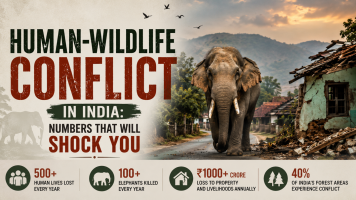
Elephants are generally non-aggressive, but they become highly dangerous when startled, provoked, or separated from their herd. Villagers who step outside at night unaware of the elephant's presence risk fatal encounters. According to government data, elephants kill over 500 people in India every year, making them one of the most dangerous large animals in terms of human fatalities.
3. Panic and Community Trauma
When an elephant enters a settlement, the entire village goes into chaos. People shout, lights are switched on, firecrackers may be used to scare the animal all of which can further agitate the elephant and worsen the situation. The psychological trauma especially for children and elderly residents can last long after the elephant has retreated.
4. Retaliatory Harm to the Elephant
Out of fear and frustration, some communities have resorted to retaliatory measures lighting fires, using electric fences illegally, or even poisoning food. This is dangerous not just for the elephants (a protected species under India's Wildlife Protection Act) but also for the humans involved. Retaliatory killings damage conservation efforts and create legal consequences for villagers.
5. Loss of Livelihoods
For farming communities, the damage from a single night's intrusion can mean no income for months. Without crop insurance or adequate government compensation, families often spiral into debt. Repeated intrusions can lead to entire communities abandoning their lands displacing people who have lived in those areas for generations.
Why Are Elephants Entering Villages More Frequently?
This is not just a wildlife problem it is a land-use and conservation crisis.
- Habitat fragmentation: As forests are cleared for agriculture, roads, and development, elephants lose their natural corridors and forage inside human settlements.
- Food scarcity inside forests: Degraded forests lack sufficient food sources, pushing elephants to raid crops.
- Loss of traditional migration routes: Elephants have memory-driven migration paths. When these paths are blocked by infrastructure, elephants often cut through villages.
- Climate change: Erratic rainfall affects forest vegetation, pushing elephants to seek food elsewhere.
As long as these pressures persist, elephant intrusions will continue and the need for proactive, technology-driven protection becomes urgent.
The Traditional Response: Why It Falls Short
For decades, communities have relied on traditional methods to deal with elephant intrusions:
- Watchmen and patrols – Human guards take shifts at night, but fatigue and limited visibility make this unreliable and dangerous.
- Firecrackers and torches – Noisy deterrents that temporarily scare elephants but habituate them over time.
- Trenches and fences – Physical barriers that elephants can cross, destroy, or circumvent.
- Community alert networks – Word-of-mouth or phone calls that are slow and often too late.
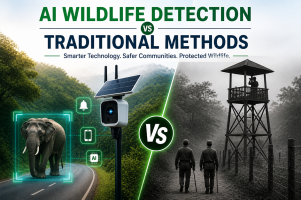
All of these methods share one critical flaw: they are reactive. By the time the alarm is raised, the elephant is already in the village.
How AI Changes Everything: The JeevaRakshak Approach
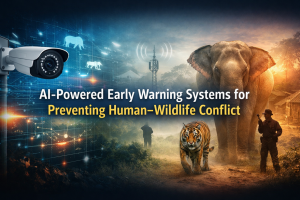
JeevaRakshak is an AI-powered wildlife detection and early warning system specifically designed to prevent human-wildlife conflict. Here's how it transforms the response to elephant intrusions:
✅ Real-Time Detection Before the Elephant Enters
JeevaRakshak uses computer vision and AI models trained to recognise wildlife including elephants from camera feeds. As soon as an elephant is detected near the perimeter of a village, farm, or settlement, the system triggers an instant alert. This happens before the animal enters the danger zone.
✅ Automated Alerts to the Right People
When a detection is made, JeevaRakshak sends simultaneous alerts to:
- Villagers and residents via mobile notifications and sirens
- Forest department officials who can dispatch rapid response teams
- Local authorities for coordinated management
No human watchman needs to be awake. No panic. Just a calm, structured, and fast response.
✅ Solar-Powered and Always On
JeevaRakshak units are solar-powered, making them ideal for remote forest-edge communities where electricity is unreliable. The system operates 24/7, 365 days a year through rain, darkness, and power cuts.
✅ Reducing False Alarms with AI Accuracy
Unlike motion sensors that trigger on passing animals, wind, or people, JeevaRakshak's AI is specifically trained on wildlife species. This means fewer false alarms and more trust from the community so people actually respond when an alert is raised.
✅ Data for Forest Departments
Every detection is logged with timestamp, location, and image data. This creates a movement history of wildlife activity invaluable for forest officials to understand elephant corridors, plan mitigation, and make evidence-based decisions about fencing or relocation.
A Scenario: With and Without JeevaRakshak
Without AI Detection:
At 2 AM, a herd of three elephants enters a village through a poorly fenced boundary. A farmer's dog barks, waking the farmer. He steps outside to check and comes face-to-face with an elephant. In the panic that follows, one person is injured, four homes are damaged, and the entire crop of paddy stored in a barn is destroyed. Forest officials are notified the next morning.
With JeevaRakshak:
At 1:45 AM, JeevaRakshak cameras detect the elephants 300 metres from the village boundary. Instant alerts are sent to 47 residents, the local forest ranger, and the district control room. Residents stay indoors. Sirens deter the elephants. The forest team arrives within 20 minutes and guides the herd back toward the forest. No injuries. No property damage. The entire incident is logged with GPS coordinates and photographs.
The difference is 15 minutes and an AI system.
Where JeevaRakshak Is Making a Difference
JeevaRakshak is designed to protect communities across multiple environments:
- Villages near forest edges in Karnataka, Kerala, Assam, Odisha, and other elephant-dense states
- Agricultural lands and farms where crop raids are most frequent
- Railway corridors passing through wildlife zones
- National highways in forest areas prone to animal crossing accidents
What Communities and Governments Can Do
Technology alone is not enough. A complete solution requires:
- Deploy AI detection systems like JeevaRakshak at village peripheries and farm borders
- Train communities on how to respond when an alert is received stay indoors, don't agitate the animal
- Strengthen forest corridors to give elephants natural migration routes away from villages
- Improve compensation mechanisms for crop and property loss, so communities view elephants as a shared responsibility rather than an enemy
- Integrate AI data with policy — use detection logs to inform long-term wildlife management plans
Conclusion
When an elephant enters a village, the cost in lives, livelihoods, and trauma is enormous. For too long, communities living on the frontlines of human-wildlife conflict have had no reliable warning system. They have relied on luck, noise, and human vigilance to protect themselves.
JeevaRakshak changes that.
By detecting wildlife before conflict occurs, alerting the right people at the right time, and building a data-driven picture of animal movement, JeevaRakshak empowers communities, supports forest departments, and ultimately protects both human lives and elephant lives.
Because the goal is not to choose between people and elephants it is to find a way for both to coexist safely.