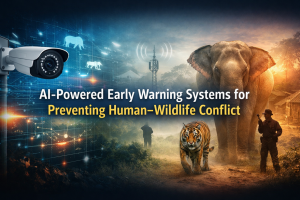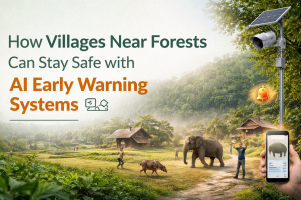
Human–wildlife conflict in India has become a serious and growing concern, especially in forest-border villages, agricultural lands, railway corridors, and highway expansion zones. With increasing urbanization and shrinking forest habitats, animals are more frequently entering human settlements, leading to crop damage, property loss, injuries, and even fatalities.
For decades, authorities have relied on traditional methods such as fencing, manual patrols, and watchtowers. While these methods have helped to some extent, they are largely reactive and limited in effectiveness.
Today, AI-powered wildlife detection systems are transforming this space by offering real-time, proactive, and scalable solutions.
This blog explores how AI compares with traditional methods and why it is becoming essential for modern wildlife conflict management.
Traditional Wildlife Protection Methods: An Overview
1. Fencing Systems
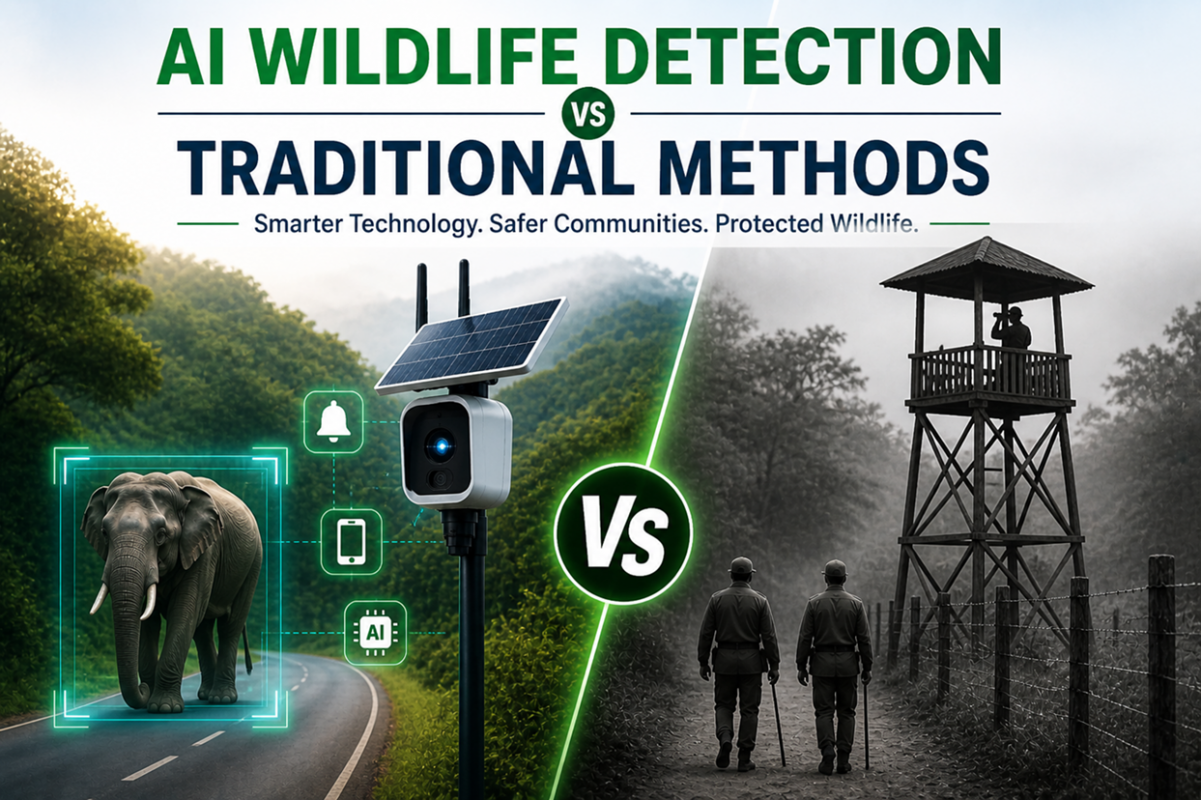
Fencing—such as electric fences, solar-powered barriers, or trench systems is widely used to prevent animals from entering farms or villages.
Advantages:
- Acts as a physical barrier
- Can deter smaller animals effectively
- Useful for defined boundaries
Limitations:
- Large animals like elephants can break or bypass fences
- Expensive to install across large areas
- Requires continuous maintenance
- Disrupts natural wildlife corridors and migration routes
- Not effective in forest buffer zones or uneven terrain
2. Manual Patrols
Forest guards or community members patrol high-risk areas to monitor animal movement and alert nearby populations.
Advantages:
- Human judgment in identifying threats
- Flexible deployment
- Useful for immediate on-ground response
Limitations:
- Limited coverage area and visibility
- Dependent on manpower and availability
- High operational costs over time
- Delayed detection often after animals have already entered
- Risk to human life during encounters
3. Watchtowers
Watchtowers are built in strategic locations to observe wildlife movement from elevated points.
Advantages:
- Wider field of view compared to ground monitoring
- Useful for daytime observation
Limitations:
- Ineffective during night, fog, or dense vegetation
- Requires continuous human presence
- No automated alert system
- Limited range and blind spots
- Not scalable across large landscapes
What Is AI Wildlife Detection?
AI wildlife detection systems use a combination of smart cameras, sensors, edge computing, and machine learning algorithms to monitor animal movement in real time.
These systems:
- Detect animals instantly using visual recognition
- Identify species (e.g., elephants, tigers, cattle)
- Trigger alerts via sirens, lights, SMS, or mobile apps
- Work in remote, off-grid environments using solar power
- Operate continuously without human intervention
Unlike traditional methods, AI systems focus on early warning and prevention, rather than reaction.
AI vs Traditional Methods: A Detailed Comparison
1. Detection Speed & Response Time
- Traditional Methods:
Detection depends on human observation, often resulting in delays. By the time an animal is spotted, damage may already have occurred. - AI Systems:
Provide instant detection and real-time alerts, allowing communities and authorities to act before an encounter happens.
👉 Early warnings can prevent crop loss, accidents, and human injuries.
2. Monitoring Capability
- Traditional Methods:
Limited by working hours, fatigue, and human attention span. - AI Systems:
Offer 24/7 continuous monitoring, regardless of weather or time.
👉 This is especially critical for nocturnal animals like elephants and leopards.
3. Coverage & Scalability
- Traditional Methods:
Difficult to scale across large forest areas, railway tracks, or highways. - AI Systems:
Can be deployed across multiple locations simultaneously and monitored centrally.
👉 Ideal for large infrastructure projects and district-level deployments.
4. Accuracy & Intelligence
- Traditional Methods:
Prone to human error, misjudgment, and missed detections. - AI Systems:
Use trained models to accurately detect and classify animals, reducing false alarms.
👉 Some systems can even predict movement patterns over time.
5. Human Safety
- Traditional Methods:
Patrol teams and villagers face direct risk during encounters. - AI Systems:
Minimize human involvement in high-risk zones.
👉 Improves safety for forest staff, farmers, and local communities.
6. Environmental Impact
- Traditional Methods:
Fencing and barriers can disrupt ecosystems and block migration routes. - AI Systems:
Are non-intrusive and eco-friendly, supporting natural wildlife movement.
👉 Promotes coexistence instead of restriction.
7. Cost & Long-Term Value
- Traditional Methods:
Ongoing costs for manpower, maintenance, and repairs. - AI Systems:
Higher initial investment, but:- Lower operational costs
- Reduced crop damage and compensation claims
- Less infrastructure damage
👉 More cost-effective in the long run.
Why Traditional Methods Alone Are No Longer Enough
With increasing:
- Infrastructure development (roads, railways, industrial corridors)
- Climate change affecting animal behavior
- Human settlements near forests
Wildlife movement has become more unpredictable and frequent.
Traditional systems lack:
- Speed
- Data insights
- Scalability
This makes them insufficient as standalone solutions.
The Role of AI in Modern Wildlife Protection
AI wildlife detection systems bring a data-driven and proactive approach:
- Real-time alerts for immediate action
- Data collection for policy and planning
- Integration with smart city and infrastructure systems
- Remote monitoring for forest departments
- Reduced dependency on manual intervention
Conclusion
Traditional wildlife protection methods like fencing, patrols, and watchtowers have served an important role for decades. However, in today’s rapidly changing environment, they are no longer sufficient on their own.
AI wildlife detection systems offer a smarter, faster, and safer alternative, enabling early warnings, reducing human risk, and supporting sustainable coexistence.
As India continues to balance development with conservation, adopting AI-driven solutions is no longer optional it is essential.