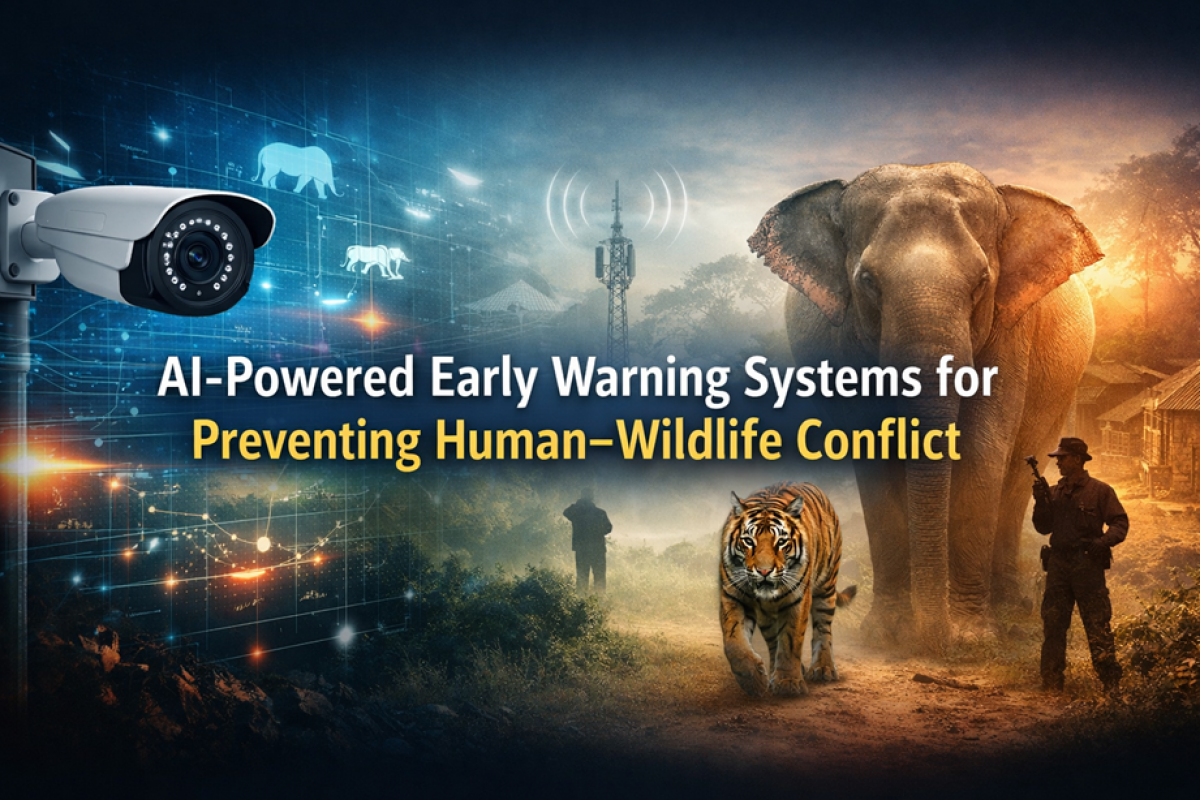
India is home to one of the world’s richest biodiversity ecosystems. From dense forests to expanding urban edges, humans and wildlife increasingly share overlapping spaces. While this coexistence is vital for ecological balance, it has also led to a growing challenge human–wildlife conflict.
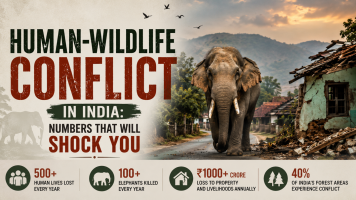
As forest habitats shrink and human settlements expand, incidents involving elephants, leopards, tigers, wild boars, and other species entering villages, farmlands, highways, and railway corridors have become more frequent. These encounters often result in loss of human life, injury to wildlife, crop destruction, infrastructure damage, and long-term social distress.
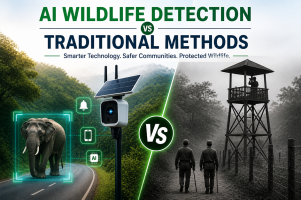
Traditional methods such as fencing, patrolling, or post-incident compensation are no longer sufficient. What is needed is a preventive, intelligent, and scalable approach and this is where Artificial Intelligence (AI) is transforming wildlife protection and public safety.
The Rising Need for Early Warning Systems
Human–wildlife conflict is no longer limited to remote forest areas. It now affects:
• Forest-fringe villages and tribal settlements
• Agricultural lands near wildlife corridors
• Highways and railway tracks passing through forests
• Urban peripheries and residential communities
Most incidents occur suddenly, often during night hours or low-visibility conditions, leaving little time for authorities or communities to react. In many cases, the absence of early warnings results in panic, injuries, retaliatory actions, and irreversible loss.
A shift from reactive response to preventive protection has become essential.
How AI Enables Preventive Wildlife Protection
AI-powered wildlife detection systems use advanced algorithms to identify animal movement in real time. Unlike conventional CCTV or manual monitoring, AI systems can:
• Detect and classify animal species automatically
• Operate continuously, day and night
• Trigger alerts before animals reach human zones
• Reduce false alarms through intelligent filtering
• Enable faster and more coordinated response
By acting before an incident occurs, AI helps protect both humans and wildlife without causing harm.
Edge AI: Designed for Remote and Rural Environments
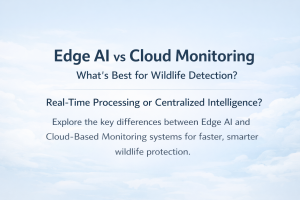
One of the biggest challenges in wildlife monitoring is unreliable electricity and internet connectivity in forest and rural areas. Modern AI systems overcome this through edge computing.
Edge AI allows data to be processed locally at the device level, ensuring:
• Operation without continuous internet connectivity
• Ultra-low response latency
• Increased data privacy and security
• Autonomous decision-making in the field
• Reduced dependency on centralized infrastructure
Combined with solar-powered operation, such systems are well suited for remote deployments where conventional technology fails.
Intelligent Alerts and Humane Deterrence
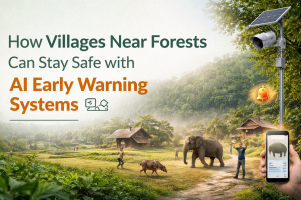
AI-based wildlife protection systems go beyond detection. When an animal is identified entering a restricted zone, the system can:
• Activate LED flash alerts
• Trigger audio deterrence systems
• Send instant notifications to villagers, forest officials, and control rooms
• Provide geo-tagged information for faster response
These non-intrusive deterrence mechanisms encourage animals to return to forest areas while alerting people in advance ensuring safety without harming wildlife.
Supporting Conservation and Coexistence
Effective wildlife protection is not about surveillance it is about coexistence.
AI-driven systems support conservation by:
• Reducing retaliatory harm to animals
• Preventing accidental deaths on roads and railways
• Minimizing stress and injury to wildlife
• Enabling data-driven conservation planning
• Strengthening trust between communities and authorities
Over time, collected insights help forest departments and policymakers understand wildlife movement patterns and design better land-use strategies.
Aligning with Government and CSR Initiatives
AI-powered wildlife protection solutions align strongly with:
• Public safety and citizen welfare goals
• Wildlife conservation and protection policies
• Smart governance initiatives
• CSR-driven social impact programs
• Indigenous technology and Make-in-India objectives
By deploying preventive early warning systems, authorities demonstrate proactive governance and long-term commitment to both people and nature.
The Road Ahead
As India continues to develop, coexistence between humans and wildlife will define the sustainability of that progress. Technology alone cannot solve the problem but responsible, intelligent, and humane use of AI can make a decisive difference.
Early detection, real-time alerts, and autonomous operation are no longer optional. They are essential tools for safeguarding lives, livelihoods, and biodiversity.
The future of wildlife protection lies not in reacting to conflict but in preventing it before it happens.